Subtotal ₹0.00

No Widget Added
Please add some widget in Offcanvs Sidebar
Shopping cart
No Widget Added
Please add some widget in Offcanvs Sidebar
Please add some widget in Offcanvs Sidebar
Please add some widget in Offcanvs Sidebar
Mangu Sarvaniya is a hardworking farmer from the village of Kachrakhadan in Petlawad Tehsil, District Jhabua. He has gone beyond traditional farming and adopted modern agricultural techniques to strengthen his economic condition. In 2022, with the support of Sampark Sanstha, various agricultural reforms transformed his farming practices into a
more profitable enterprise. By adopting land leveling, organic farming,vermicomposting, drip irrigation, horticulture, and indigenous seed conservation, he not only increased his yield but also became a source of inspiration for other farmers in his village.

Mangu owned 3 bighas of cultivable land, of which 1 bigha remained fallow. Due to uneven and sloped land, water retention was poor, causing irrigation issues. As a result, he could only grow Kharif crops like cotton and maize, with limited production—3 quintals of cotton and 7-8 quintals of maize. Lack of water resources prevented him from growing wheat in the Rabi season, and chickpea production was only 20–30 kg. Excessive use of chemical fertilizers had reduced soil fertility and increased input costs.
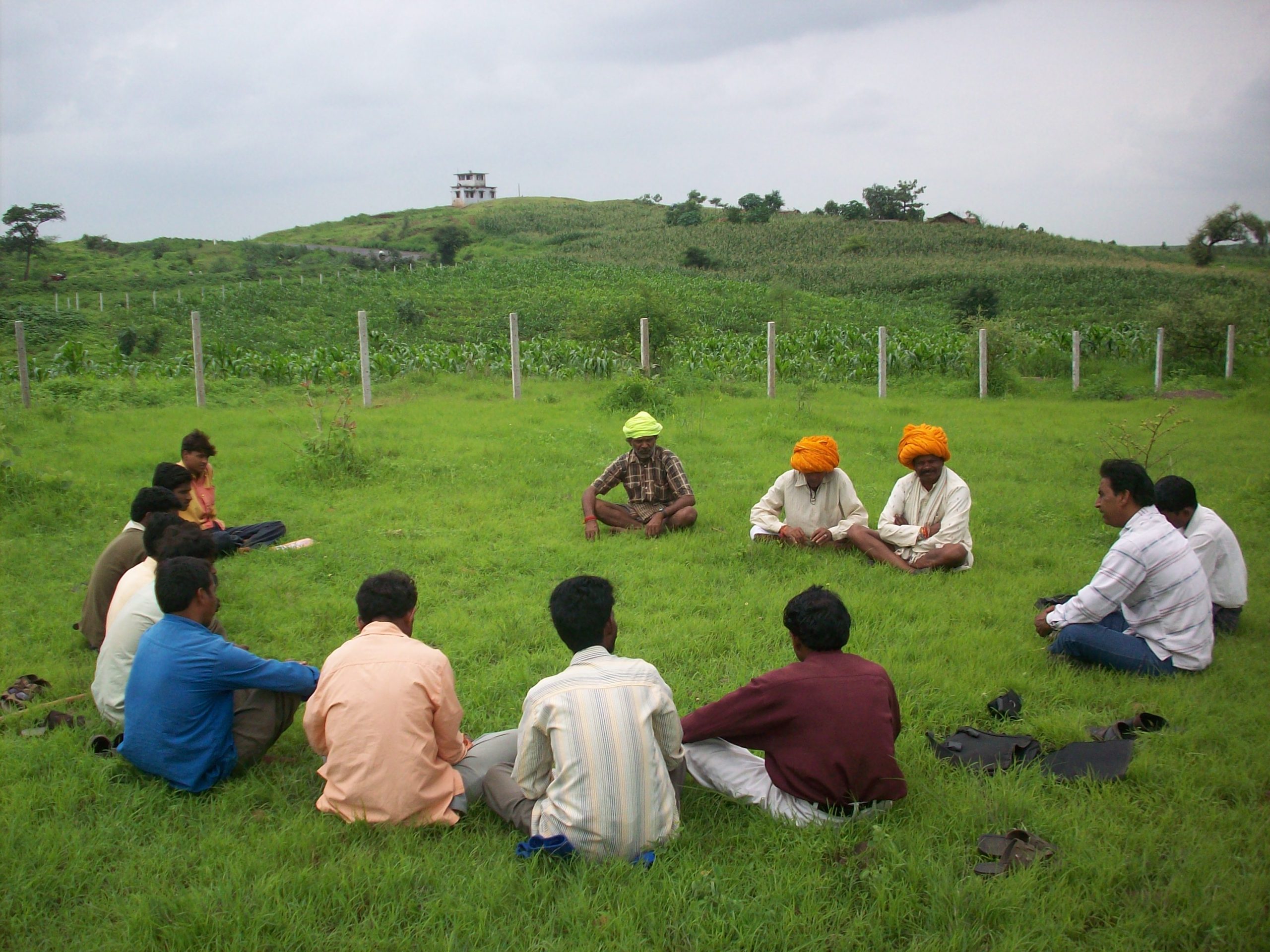
Mangu’s success has inspired other farmers in his village. Seeing the benefits of organic manure, drip irrigation, and crop diversification, many have started adopting these techniques. Mangu actively participates in Kisan Chaupal (farmer gatherings) and training programs where he shares his success story and motivates others to adopt improved agricultural practices.
The story of Kantu Badru Bariya, a farmer from
Semalkundiya village in Mohankot Panchayat, Jhabua district, is an inspiring example of how land improvement and technical support can enhance a farmer’s agricultural productivity and economic well-being. By utilizing agricultural reforms, Kantu has brought positive changes to his life.
Kantu’s major problem was waterlogging in his field during the monsoon, which led to the destruction of his Kharif crops and decreased productivity. Due to this, he was often forced to migrate and work as a labour to support his family.
In a village-level meeting organized by the supporting
organization, Kantu learned about land development and
field bunding techniques. He agreed to become a member
of the farmers' committee and registered his name for the bunding work, sharing his land-related challenges.
All committee members present at the meeting approved the bunding work for his field. The organization carried out drainage construction with a JCB machine and levelled the land using gravel and soil fill.
Kantu participated in skill-building training provided at the village level by the organization and purchased a drip irrigation system for 1 bigha of land. With water conservation and improved crop yields, he started using drip irrigation for tomatoes, watermelon, and cucumber.
Kantu expressed his deep gratitude towards the organization for their support and technical guidance, stating that the transformation would not have been possible without their help. Thanks to this support, he is now a self-reliant farmer and has become a Master Trainer with the organization, providing training and information to other farmers at the village level.
The inspiring journey of Hursing Amra Bariya, a farmer from Semalkundiya village in Madhya Pradesh, is a shining example of how self-reliance, hard work, and timely technical support can lead to success in agriculture. Earlier, Hursing relied on traditional farming, where problems like
waterlogging during the rainy season, limited irrigation facilities, and low yields kept his income minimal. These challenges forced him to migrate for labour work to sustain his family’s livelihood.
Under the Livelihood Project implemented by Sampark Social Organization, Semalkundiya village was selected, and several development activities were initiated. The aim was to introduce farmers to water-saving techniques, land development, and modern farming methods. Hursing actively participated in the meetings and trainings
conducted by the organization. He learned about land improvement, water conservation, vermicomposting, preparing organic pesticides, and drip irrigation. Through the organization support and linkage with various schemes, he began improving his farming practices. With the organization help, field bunding and land levelling were carried out on Hursingh land. Around 30 tractor trolleys of soil were filled using JCB to solve the waterlogging issue. After this intervention, he began cultivating new crops and saw a significant increase in yield.
With the organization’s support and his dedicated efforts, Hursing adopted multiple modern agricultural techniques, resulting in remarkable income growth:
Earlier, Hursing’s annual income was only around ₹30,000–₹40,000, but now it has increased to over ₹1.5 lakh. By adopting modern techniques, new crops, and water-saving methods, his economic condition has significantly improved, elevating his family’s living standards.