Subtotal ₹0.00

No Widget Added
Please add some widget in Offcanvs Sidebar
Shopping cart
No Widget Added
Please add some widget in Offcanvs Sidebar
Please add some widget in Offcanvs Sidebar
Please add some widget in Offcanvs Sidebar
Sohan Mansing Ninama resides in Dholikhali village, which is home to about 250–300 tribal families. Approximately 40–50% of the village land is cultivable, while the rest remains fallow. Farmers primarily use ponds and streams for irrigation. Sohan lives with his family of four, including two children who are pursuing their education. He grows maize, soybean, and cotton in the kharif season and wheat in the rabi season.
A decade ago, Sohan, like many traditional farmers, used to conserve and sow his own seeds—particularly pulses, oilseeds, and grains like moong, urad, tur, maize, and sesame. However, with the increasing dominance of commercial crops such as cotton and soybean, traditional crops began to disappear from his fields. This forced Sohan to depend on the market for expensive seeds, increasing input costs and reducing his autonomy.
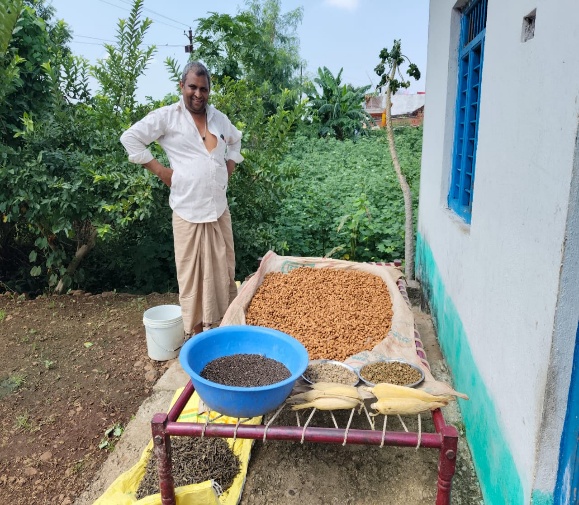
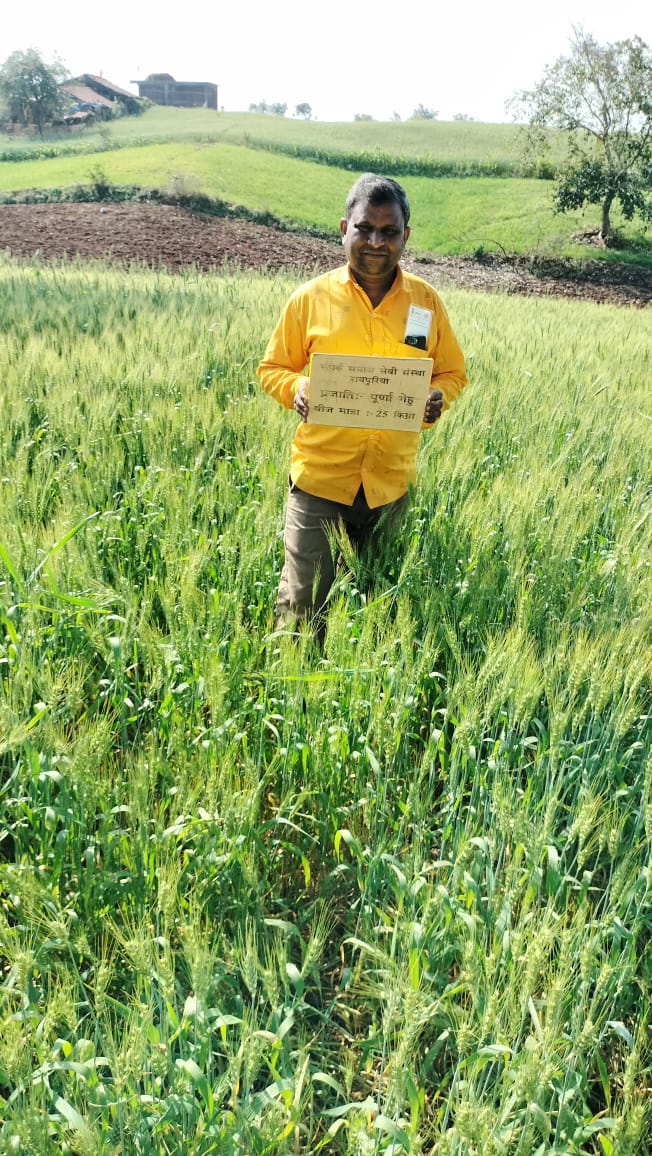
Under the Livelihood Project by Sampark, Dholikhali was selected for a series of agricultural innovations aimed at reducing costs and improving productivity. One of the core interventions was traditional seed conservation.
Sohan attended community meetings and joined the village farmers’ committee. He participated in a seed conservation workshop organized by the project, where the significance and utility of traditional, climate-resilient seeds were explained. Encouraged by this, Sohan sowed seeds of soybean, maize, tur, sesame, moong, groundnut, and urad in different plots of his land.
Within two years, Sohan achieved impressive yields:
He retained seeds for future sowing, including:
He sold the surplus and earned ₹10,000, while also saving approximately ₹6,000, which he would have otherwise spent on buying seeds from the market.
Sohan is now committed to organic farming and seed conservation. By reducing his input costs, improving yields, and reviving local biodiversity, he has moved significantly towards sustainable and self-reliant agriculture.
Grateful to Sampark, Sohan continues to inspire other farmers in his village to preserve traditional seeds and adopt eco-friendly agricultural methods. His story serves as a powerful example of how indigenous knowledge paired with modern techniques can restore autonomy, resilience, and prosperity in tribal farming communities.
Tejudi Bai resides in Kachrakhadan village, part of the Kachrakhadan Gram Panchayat. The village houses around 400–500 tribal households, and agriculture is the primary source of livelihood. Around 60–70% of the land is cultivable, while 30% remains fallow. Irrigation is done through rivers, wells, and tube wells, and most families own 4–5 livestock. The land is classified as semi-irrigated.
Tejudi lives with her husband, while her son and daughter-in-law have migrated for work. She cultivates maize, soybean, and cotton in the kharif season, and wheat and gram in rabi.
A decade ago, Tejudi conserved and used her own traditional seeds—pulses, oilseeds, and grains—on her farm. However, due to the rise in monoculture crops like cotton and soybean, traditional crops like moong, urad, tur, maize, and sesame gradually vanished from her fields. This increased her dependence on market seeds, which were often costly and added financial strain.
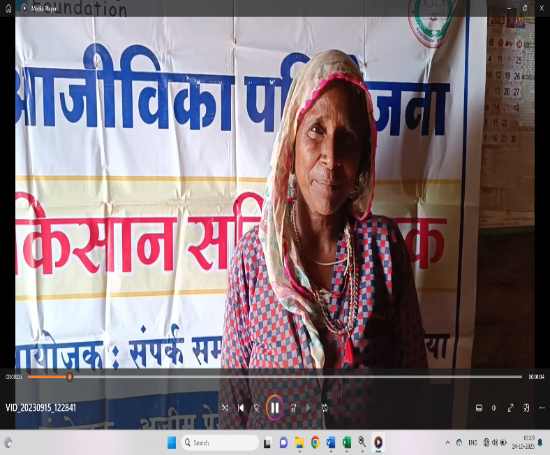
With the intervention of Sampark NGO through its Livelihood Project, Kachrakhadan was selected for multiple development activities aimed at reducing input costs and improving yields. One of the most effective initiatives was reviving traditional seed conservation, under the banner of “Ghar ka Beej Ghar Mein” (Our Seed, in Our Home).
Tejudi enrolled in the village farmer committee and participated in meetings conducted by Sampark. The organization explained the importance of preserving traditional seeds and how it can reduce market dependency.
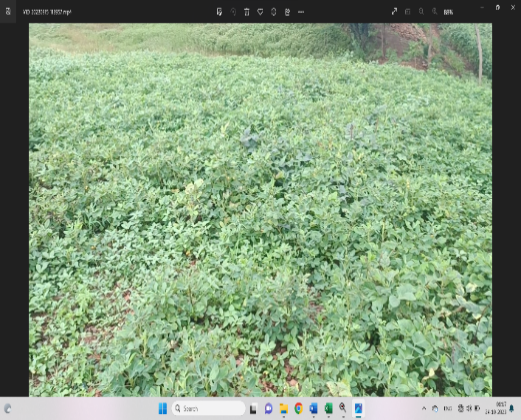
She then attended a seed enhancement workshop at the Sampark campus, where she received a deeper understanding of traditional seed use. She brought back seeds of soybean, maize, tur, sesame, groundnut, urad, and moong, which she planted in different plots.
From this initiative, Tejudi produced:
For future cultivation, she preserved:
She sold the remaining produce, earning ₹6,000, and saved an additional ₹5,000, which she would have spent on buying seeds from the market.
Tejudi says this initiative freed her from market dependency, and she achieved good yields with minimal costs. She has now made it a habit to preserve seeds at home, and is committed to traditional seed conservation for the future.
Grateful to Sampark, she expresses that their support helped her move toward organic and sustainable agriculture. Tejudi now motivates fellow farmers in her village to adopt traditional seed preservation, setting an example of self-reliance and ecological responsibility.
Tejudi Bai’s story proves that reviving forgotten practices with the right support can empower even small farmers to reclaim control over their land, crops, and income.
Tejudi Bai resides in Kachrakhadan village, part of the Kachrakhadan Gram Panchayat. The village houses around 400–500 tribal households, and agriculture is the primary source of livelihood. Around 60–70% of the land is cultivable, while 30% remains fallow. Irrigation is done through rivers, wells, and tube wells, and most families own 4–5 livestock. The land is classified as semi-irrigated.
Tejudi lives with her husband, while her son and daughter-in-law have migrated for work. She cultivates maize, soybean, and cotton in the kharif season, and wheat and gram in rabi.
A decade ago, Tejudi conserved and used her own traditional seeds—pulses, oilseeds, and grains—on her farm. However, due to the rise in monoculture crops like cotton and soybean, traditional crops like moong, urad, tur, maize, and sesame gradually vanished from her fields. This increased her dependence on market seeds, which were often costly and added financial strain.